Housing has a significant impact on greenhouse gas emissions in France. Heating, hot water, building materials, electricity consumption: each category contributes to a home’s carbon footprint. Since 2025, the obligations related to the Energy Performance Certificate (DPE) have become stricter for landlords, and MaPrimeRénov’ still funds certain energy renovation works. Here are ten concrete tips to make your home more eco-friendly, categorized by level of intervention.
1. Install exterior solar protections before considering air conditioning
Most guides focus on winter insulation. Summer comfort remains the neglected aspect of renovations. A document published on data.gouv.fr by Fonciris shows that homes without exterior solar protection are predominantly rated “insufficient” by the summer comfort indicator of the DPE.
Adjustable sunshades, slatted shutters, exterior blinds: these devices block radiation before it passes through the glazing. Their cost remains moderate compared to air conditioning, and they consume no energy. Integrating this consideration from the start avoids layering corrective solutions afterward.
Resources like lamaisondurable.com allow for a deeper exploration of material and equipment choices suited to each housing configuration.
2. Favor the thermal inertia of walls rather than just the thickness of insulation
Adding centimeters of insulation is not enough to ensure a comfortable home year-round. Thermal inertia is the ability of walls to store heat during the day and release it at night. Heavy materials (stone, solid brick, rammed earth) provide this natural regulation.
In renovations, insulating from the outside preserves the inertia of existing walls. Insulating from the inside, on the other hand, cuts this thermal mass off from the habitable volume. This technical choice has direct consequences on summer comfort, a parameter that the DPE is beginning to consider, even though the current indicator does not take local climate into account according to the Fonciris document.
3. Replace your heating system considering the regulatory timeline
MaPrimeRénov’ still funds the replacement of fossil fuel boilers, but significant changes are announced for 2027. The amounts and conditions evolve each year. For homeowners heating with oil or old gas, replacing with a heat pump or pellet stove remains one of the most cost-effective actions in terms of emissions reduction.
The timeline is also important for landlords: homes rated G on the DPE are progressively banned from rental. Class F will follow. Waiting increases the risk of having to renovate in an emergency, with overwhelmed craftsmen and potentially reduced aid.
4. Choose biosourced and local materials for each project
Wood wool, cellulose wadding, hemp, cork: these biosourced insulators store carbon instead of emitting it during their production. Their thermal performance is comparable to mineral wools at standard thicknesses.
Local sourcing reduces transportation and supports regional industries. Here are some concrete criteria to guide your choice:
- Check certification (ACERMI for insulators) and the fire reaction class suitable for the intended use
- Compare thermal conductivity (lambda) at equivalent thickness, not just the price per square meter
- Favor recyclable materials at the end of their life to limit the overall footprint of the project
5. Collect rainwater for non-potable uses
Watering the garden, flushing toilets, outdoor cleaning: these uses do not require drinking water. A rainwater harvesting system with an underground tank covers a significant portion of these needs. The consumption of drinking water decreases significantly from the first year of use.
The installation requires a separate network in the house, clearly identified to avoid any connection with the drinking water circuit. Regulations require a disconnect device and labeling of withdrawal points.
6. Switch to LED lighting with presence detectors
Replacing halogen or compact fluorescent bulbs with LEDs reduces lighting consumption by four to five times. Adding presence detectors in hallways, staircases, and passage rooms eliminates forgetting to turn off lights.
A often overlooked point: color temperature influences visual comfort and sleep. Favor warm white LEDs (less than 3,000 K) in living areas and reserve cool white for technical spaces.
7. Ventilate properly without wasting heat
An eco-friendly home is not an airtight home. Without sufficient ventilation, humidity accumulates, indoor pollutants stagnate, and air quality deteriorates. The double-flow ventilation system recovers heat from outgoing air to preheat incoming air. It reduces losses associated with air renewal, a category that represents a significant portion of heating bills in well-insulated homes.
Maintaining filters and vents is essential for the system to function effectively. A clogged filter negates part of the energy and health benefits.
8. Eliminate toxic household products in favor of simple formulas
White vinegar, baking soda, black soap: these three products cover most domestic cleaning needs. Conventional household products release volatile organic compounds (VOCs) that pollute indoor air, sometimes more than urban outdoor air.
The issue goes beyond ecological gestures. It directly concerns the health of occupants, especially in newer, highly airtight homes where pollutants concentrate.
9. Size your home according to your actual needs
Every additional square meter consumes energy for heating, lighting, and maintenance. Reducing the living area to actual needs is the most underestimated ecological lever. Before expanding or building, the question deserves to be asked: which rooms are actually used daily?
This reasoning also applies to equipment. An oversized water heater maintains a volume of water at temperature unnecessarily. An overly powerful heating system operates at low capacity, which degrades its efficiency.
10. Generate part of your energy with self-consumed solar panels
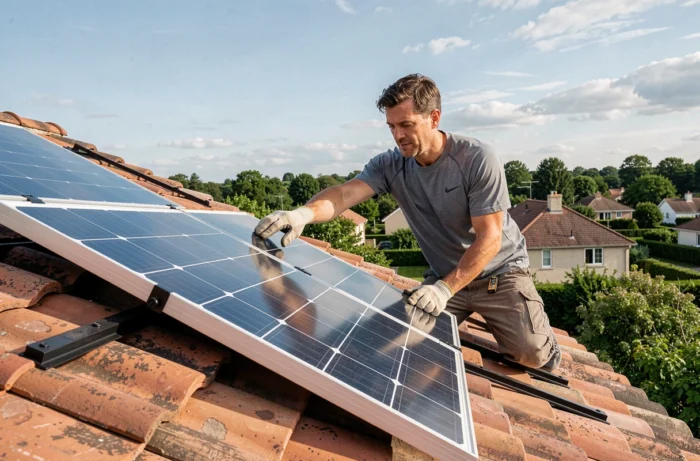
Photovoltaic self-consumption allows you to cover a fraction of your daytime electricity consumption. The surplus can be fed back into the grid or stored in a home battery. Public aid still exists, but its sustainability beyond 2027 is not guaranteed.
Here are a few points to check before getting started:
- The orientation and inclination of the roof affect productivity: a south-facing slope with a pitch close to 30 degrees remains ideal in mainland France
- The sizing of the installation must match the household’s actual consumption profile, not just the available roof area
- Profitability depends on the buyback rate in effect at the time of connection, a parameter that changes every quarter
Making your home eco-friendly is not just about accumulating isolated gestures. The most effective choices concern the building itself: inertia, solar protection, ventilation, sizing. Daily habits complement these structural interventions but do not replace them.