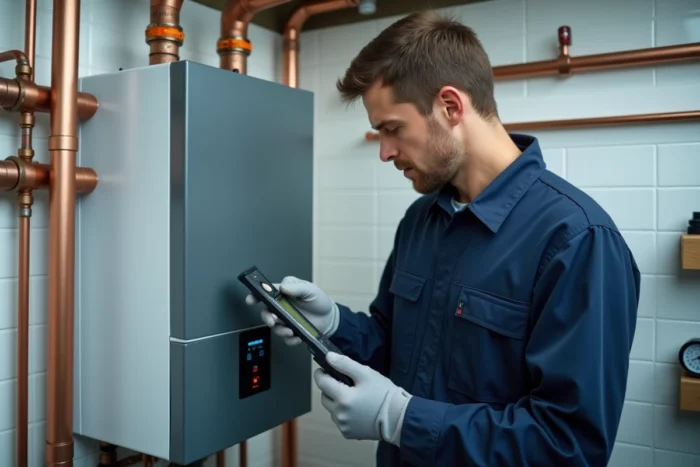
Your gas boiler is showing signs of fatigue, the bill is rising, and you are wondering what to replace it with. The topic may seem technical, but the choices boil down to a few simple questions. Replacing your gas boiler in 2026 means navigating between what is still allowed, what is financially supported, and what actually corresponds to your home.
Flue and connections: the technical point that conditions everything else
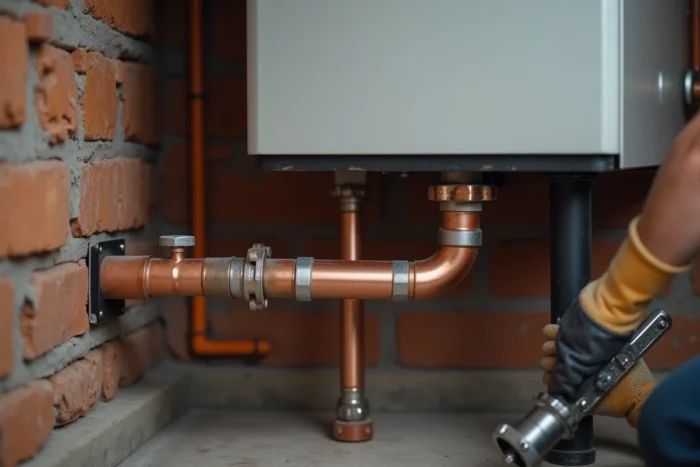
Before comparing equipment, take a look at your current installation. The type of flue for exhaust gases determines what you can install, sometimes more than your budget.
A balanced flue boiler (horizontal exhaust at the front) cannot be connected to a vertical chimney flue, and vice versa. If your home has a collective flue in a building, the options are even more limited.
In concrete terms, the diagnosis of the existing flue guides the choice of equipment. A serious installer starts there, not with a quote. If the flue is incompatible with the proposed solution, you will need to plan for flue lining or the creation of a balanced flue outlet, which alters the overall budget.
To better understand the solutions for changing a gas boiler according to your configuration, you must first identify this technical point, as it naturally filters viable options.
Condensing gas boiler or heat pump: two different logics
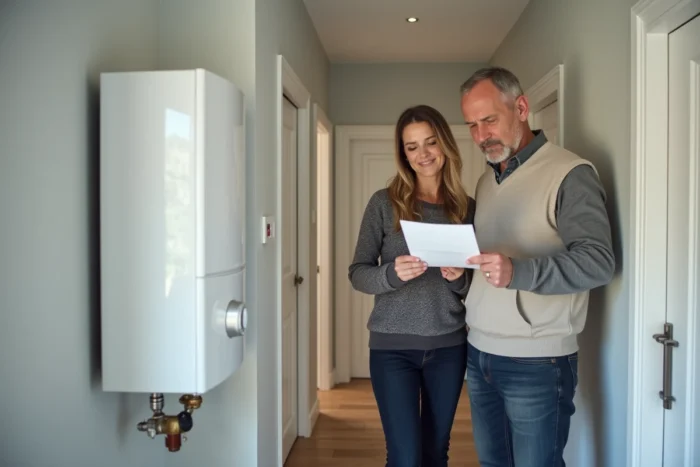
Are you hesitating between keeping gas or switching to a heat pump? The answer depends less on the technology than on your situation.
Staying with gas using a condensing boiler
In existing housing, the condensing gas boiler remains legally installable in 2026. It recovers heat from the exhaust gases to preheat the return water, which improves efficiency compared to a conventional model.
However, it no longer qualifies for MaPrimeRénov’ and the applicable VAT is 20%. Its operating cost remains linked to the price of gas, with no financial boost for installation.
This choice makes sense if your radiator network works well, if the flue is compatible, and if you are looking for a quick intervention with a controlled budget in the short term.
Switching to an air-water heat pump
The air-water heat pump captures heat from the outside air to heat the water in the circuit. It often connects to existing radiators, provided they are sized to operate at low temperatures.
The heat pump divides energy consumption by two to three compared to a gas boiler, depending on the insulation of the home and the local climate. It is eligible for financial aid (MaPrimeRénov’, CEE), which reduces the remaining costs.
The downside: the initial investment is higher, the outdoor unit produces noise that needs to be anticipated (distance from neighbors), and performance decreases in very cold weather. In regions with harsh winters, supplementary heating may be necessary.
Financial aid for replacing a gas boiler in 2026
The landscape of aid has changed. Here’s what applies concretely based on the chosen equipment:
- MaPrimeRénov’ finances the installation of a heat pump, biomass boiler, or combined solar system. The amount varies according to household income and the nature of the work.
- Energy savings certificates (CEE) complement MaPrimeRénov’ for high-performance equipment. They are paid by energy suppliers in the form of a bonus.
- The zero-interest eco-loan (éco-PTZ) allows financing of the remaining costs without interest, up to a ceiling set by regulations.
One point to remember: the condensing gas boiler no longer benefits from any public aid. If you stay with gas, the total cost is entirely your responsibility. This shift in aid can reverse the economic calculation in favor of the heat pump over a period of ten to fifteen years.
New vs existing: two regulations not to be confused
Confusion is common, and it can be costly in lost time. Why does this distinction matter?
Since January 1, 2022, the RE 2020 prohibits the installation of gas boilers in new individual homes. From January 2025, this prohibition extends to new collective housing. And the government announcement in April 2026 confirms that no gas boiler will be installable in new buildings by the end of 2026.
In renovation, replacing a gas boiler with another is still allowed. No law requires a homeowner to change energy sources when replacing in existing housing. The pressure is financial (no aid, full VAT), not regulatory.
This distinction changes the strategy: if you are building or buying a new home, gas is simply no longer an option. If you are renovating, the choice is yours, but incentives clearly steer towards renewable energies.
Maintenance and lifespan: what weighs after installation
The purchase price represents only part of the real cost. Annual maintenance is mandatory for both gas boilers and heat pumps, but the items differ.
- A condensing gas boiler requires an annual visit (burner check, combustion analysis, leak test). The cost is moderate and specialized technicians are numerous.
- A heat pump also requires mandatory annual maintenance, with verification of the refrigeration circuit. Qualified technicians are fewer in some areas, which can extend waiting times.
- The average lifespan of a well-maintained condensing gas boiler is around fifteen years. An air-water heat pump has a comparable lifespan, provided the compressor is properly sized.
An improperly sized unit wears out faster, regardless of the type. Oversizing causes short cycles (the device turns on and off too often), which stresses the components. Precise sizing, based on the actual thermal losses of the home, remains the most determining factor for longevity.
Replacing a gas boiler is not just a catalog choice. The configuration of the flue, the current aid regime, and the calculation of the total cost over ten to fifteen years make the difference between a profitable decision and a poorly calibrated investment. Having a thermal assessment done before any decision remains the most useful and least costly precaution.