
A 15m3 truck is a Renault Master, a Fiat Ducato, or an Iveco Daily with a loading space whose actual usable volume ranges between 13 and 14.5 m3 depending on the model and interior layout. The difference between the advertised volume and the usable volume determines everything else: the number of boxes, accepted furniture, and the number of trips. Understanding what can be loaded into a 15m3 truck requires thinking in terms of weight and shapes, not just cubic meters.
Authorized total weight and license thresholds: the constraint that volume does not show
A rented 15m3 truck is almost always approved for a total weight of 3.5 tons. The empty vehicle weighs between 2 and 2.3 tons depending on the engine type and the presence of a tailgate. This leaves between 1.2 and 1.5 tons of actual payload.
A furnished T2 with appliances, dishes, and books easily exceeds a ton. Loading “everything that fits” into the volume without weighing it amounts to driving overloaded, with the risks of fines, loss of insurance in case of an accident, and degraded braking.
We recommend always weighing boxes of books and dishes as you load. A standard box of books weighs between 20 and 30 kg, and about thirty of these boxes can consume half of the payload without occupying a third of the volume.
Another often overlooked point: the combination of a 15m3 truck plus a trailer, increasingly common to avoid a second trip, changes the license thresholds. As soon as the total exceeds 3.5 tons of combined weight, a standard B license is no longer sufficient. Check the F.2 mention on the registration document of the rented vehicle before attaching anything.
Actual usable volume of a 15m3: interior dimensions and usable shapes
To properly anticipate what can be loaded into a 15m3 truck, you need to think in terms of interior dimensions rather than gross volume. The usable length of the floor is around 3.5 to 4 meters, the width between 1.7 and 1.8 meters, and the height under the roof between 1.9 and 2.1 meters.
These dimensions mean that a standard three-seater sofa (about 2 meters long) fits flat in the width. A 2-meter high wardrobe must travel lying down if the interior height is less than 2 meters, which consumes much more floor space.
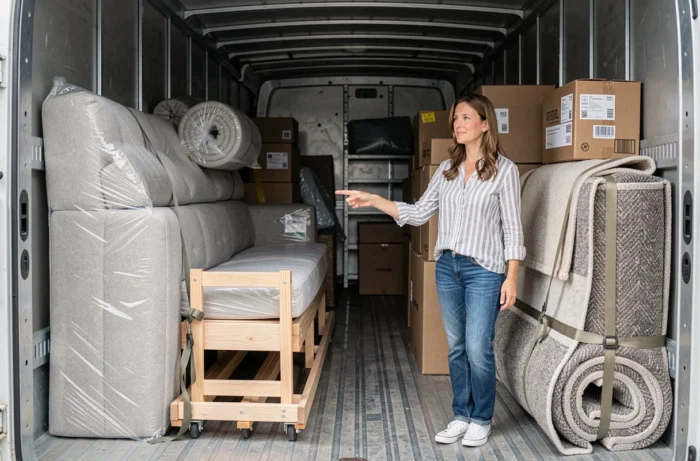
The real limiting factor is not the volume but the floor space. A 140×190 mattress laid flat occupies almost the entire width and a good part of the length. Placing it upright against a wall frees up the floor for heavy furniture.
Typical housing and realistic filling
- Studio or lightly furnished T1: the 15m3 is oversized, a 10m3 is sufficient in most cases. The 15m3 is justified if you have a convertible sofa, a desk, and more than twenty boxes.
- Standard T2: this is the main use case for the 15m3. A double bed, sofa, table with four chairs, dresser, a few shelves, common appliances (washing machine, refrigerator), and about forty boxes fit in a single load, provided a rational loading plan is followed.
- Well-furnished T3: the 15m3 reaches its limits. With two beds, a complete living room, a six-seat dining table, and more than fifty boxes, a second trip or switching to a 20m3 becomes necessary.
Loading plan for a 15m3 truck: order and distribution of weights
The heaviest items are loaded first, at the back and center of the floor. The washing machine, refrigerator, and boxes of books form the base. This distribution lowers the center of gravity and stabilizes the vehicle while driving.
Next come the disassembled furniture. We observe that systematically disassembling table legs, bed frames, and shelves easily gains one to two cubic meters of usable space. Boards and uprights can be slid vertically against the side walls, freeing up the center for irregular volumes.
Boxes and fragile items: the top layer
Light boxes (clothes, linens, toys) are placed last, on top of the furniture and appliances. Interspersing blankets or covers between layers protects surfaces without consuming volume.
A refrigerator must travel upright, secured against the back wall. Laying it down damages the cooling circuit. Plan to use a ratchet strap to secure it to an anchor point in the truck.

Long items (curtain rods, skis, step ladders) are slid in last along the ceiling or above the lying furniture. They cannot support weight, so they always go on top.
Pressure on the rental fleet: anticipate the availability of a 15m3
Registrations of light commercial vehicles have decreased by about 16.6% year-on-year as of summer 2026. This decline in the new fleet affects rental companies: rental slots for a 15m3 during peak demand periods (end of the month, summer, school holidays) are becoming scarce.
Booking two to three weeks in advance is becoming the norm to obtain a vehicle with a tailgate, an option that radically changes the loading of a washing machine or a heavy sofa. Without a tailgate, plan for a ramp and at least two people for loads over 40 kg.
- Check the payload stated in the rental contract, not just the advertised volume.
- Ask for the presence of anchor points and straps in the loading compartment.
- Confirm the actual interior height if you need to transport a wardrobe upright.
Choosing a 15m3 truck remains the best compromise for a standard T2, provided you do not think solely in terms of volume. The payload, floor space, and loading order determine the success of the move more than the number of cubic meters displayed on the rental company’s sheet.