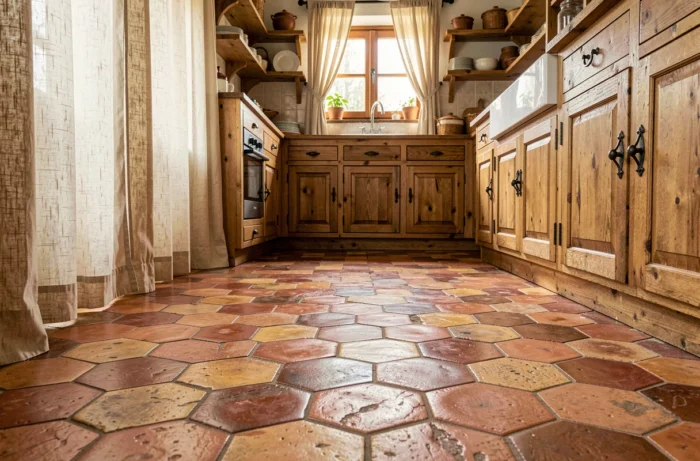
The imitation old tile flooring replicates the brick red hue, surface irregularities, and patina of a terracotta floor, but on a porcelain stoneware base. Comparing these two materials based on specific technical criteria (porosity, slip resistance, compatibility with other coverings) allows for the selection of suitable combinations without compromising the floor’s durability.
Porcelain stoneware with terracotta effect vs. authentic tile: selection criteria
The difference between a real tile and its porcelain stoneware imitation goes beyond aesthetics. The table below summarizes the technical discrepancies that directly influence possible combinations in an interior.
| Criterion | Old tile (terracotta) | Imitation tile (porcelain stoneware) |
|---|---|---|
| Porosity | High, requires regular water-repellent treatment | Very low, vitrified surface |
| Dimensional regularity | Variable (handcrafted) | Precise industrial calibration |
| Color over time | Evolves with natural patina | Stable, fixed color |
| Slip resistance rating (shod feet) | Not classified as standard | R9 to R11 depending on ranges (DIN 51130 standard) |
| Maintenance | Regular treatments, vigilance on stains | Almost none |
| Compatibility for mixed installation | Irregular thickness, delicate joints | Constant thickness, straight joints |
The difference in porosity is the most structuring parameter. A porous terracotta floor absorbs water and grease splashes, limiting the materials that can be placed nearby without creating maintenance breaks. The porcelain stoneware with terracotta effect eliminates this constraint and opens up the field for combinations, including in a kitchen or bathroom.
To combine an imitation old tile flooring with other coverings, the dimensional regularity of porcelain stoneware facilitates level connections between two materials laid edge to edge.
Color palette and tile combinations with imitation tile
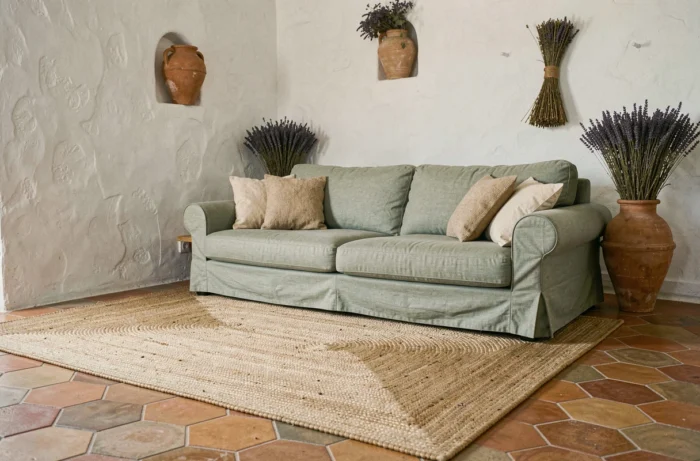
The dominant hue of an imitation tile ranges between brick red, rosy brown, and ochre. These warm tones guide the choice of complementary tiles towards two opposing logics that produce very different results.
Contrast with cool or neutral tones
A matte white tile or light gray porcelain stoneware laid in an adjacent room creates a sharp break with the red of the tile. White amplifies the warmth of red through contrast, which works particularly well in a kitchen-living room transition where the imitation tile dresses the kitchen and a light floor extends the living room.
Blue-gray or sage green tones in small formats (backsplash, niche) also interact with terracotta without overwhelming the space. However, a dark anthracite gray combined with a dark tile risks darkening the area, especially if natural light is low.
Ton-on-ton harmony with wood and warm tones
Wood remains the most documented combination in country or farmhouse style interiors. A light oak parquet or wood imitation tile in honey tones creates a chromatic continuity with the imitation tile. The risk here is monotony: without a breaking element, the whole turns into a uniform color scheme.
To avoid this pitfall, here are some concrete guidelines:
- Introduce a mineral element (gray natural stone countertop, polished concrete basin) that breaks the warm dominance
- Vary formats: if the tile is hexagonal, opt for rectangular or herringbone tiles in the adjacent room
- Limit brown and red tones to a maximum of two surfaces per room (floor + one wall or floor + furniture), with the rest in neutral color
Slip resistance rating: a technical criterion often overlooked in combination choices
Decorative content rarely addresses slip resistance, yet this parameter conditions the choice of tile in wet areas. For an imitation tile floor laid in a kitchen or bathroom, two ratings coexist:
- R9 to R11 rating (DIN 51130 standard): adhesion for shod feet. R9 is suitable for dry areas, R10 for kitchens, R11 for entrances exposed to water
- A, B, C rating (DIN 51097 standard): adhesion for bare feet in very wet areas. A for standard use, B and C for showers and critical zones
- Real terracotta, not classified as standard, offers natural adhesion due to its rough surface, but this roughness complicates cleaning
When combining an imitation tile with another tile in the same room (for example, a main floor in tile and a smooth porcelain stoneware shower tray), it is essential to check that both coverings achieve a slip resistance level compatible with the use. A glossy tile placed next to a matte imitation tile also creates a visual discrepancy that may accentuate the texture difference in an unflattering way.
Room by room: where imitation old tile works best
Not all rooms benefit equally from an imitation tile floor. The red-ochre color and hexagonal format impose a strong visual presence that must be measured.
The kitchen is the natural setting for this tile. The terracotta hue pairs well with solid wood countertops, white cabinet fronts, or zellige backsplashes. The porcelain stoneware resists grease splashes where a real tile would require treatment every two years.
In an entryway, the imitation tile immediately marks the style of the house. Combined with a white plastered wall or a dark-painted wainscot, it establishes an atmosphere without needing any other decorative element on the floor.
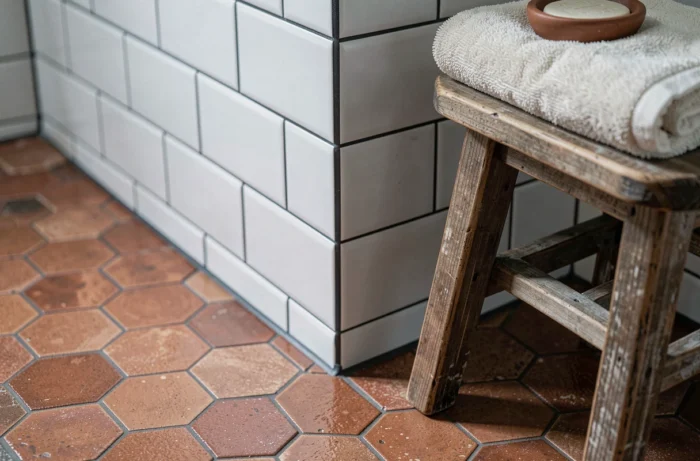
In the bathroom, the choice depends on the slip resistance rating. A porcelain stoneware imitation tile rated R10 or R11 is suitable for the general floor, but the shower area requires a covering rated B minimum for bare feet. Installing two different tiles in the same bathroom requires careful expansion joints and color consistency between the two materials.
The living room remains the space where the imitation tile is most divisive. On large surfaces, the repetition of the red hexagonal pattern can saturate the space. Limiting the tile to a defined area (fireplace corner, dining space) and combining it with a neutral floor for the rest of the room produces a more balanced result.
The key takeaway before finalizing a project is to systematically check the slip resistance rating of the chosen porcelain stoneware based on each room. This technical parameter, rarely displayed in stores, determines both safety and coherence between the associated coverings.