The kerterre is a round habitat, handcrafted from a mixture of hemp and lime, invented by Evelyne Adam in Brittany. Its machine-free construction and reduced ecological footprint attract proponents of alternative projects. Before committing, several technical, regulatory, and practical constraints deserve careful examination.
Decennial insurance and kerterre: a rarely anticipated obstacle
Most guides dedicated to the kerterre detail the hemp-lime mixture or the poetry of participatory construction. The insurance aspect remains absent, even though it conditions the very feasibility of the project.
As soon as the work falls under the scope of decennial liability, coverage is legally expected before the site opens. For self-built construction, obtaining a damage insurance or decennial coverage is an obstacle course. Traditional insurers frequently refuse to cover non-standard techniques, and the handcrafted hemp-lime mixture does not fall under any DTU (Unified Technical Document).
Gathering reviews on the disadvantages of the kerterre helps gauge the extent of this blockage before incurring expenses. Without decennial coverage, reselling the property becomes practically impossible, and any structural damage remains entirely the owner’s responsibility.
Termite resistance and soil protection: an underestimated technical constraint
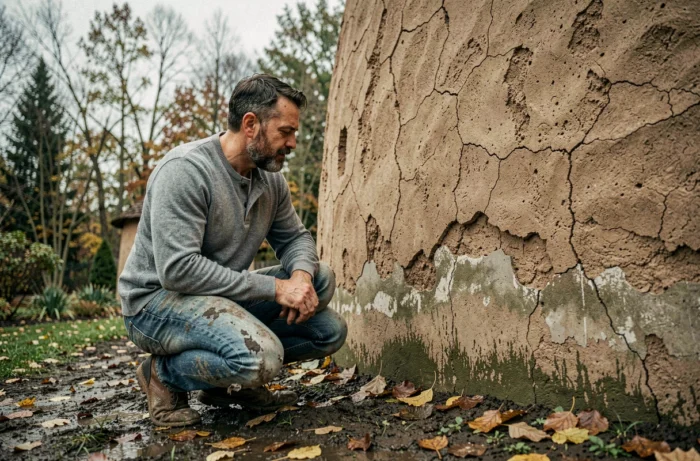
The kerterre rests directly on the ground or on a very low foundation. This proximity to the ground exposes the structure to a rarely mentioned risk: infestation by termites in areas covered by a prefectural order.
New constructions located in these sectors must integrate a protection system at the soil-building interface from the design stage. For a lightweight habitat made from bio-sourced materials, compliance poses a real technical problem. Hemp does not offer the same resistance as concrete or steel against wood-eating insects, and the joinery elements (doors, window frames) remain vulnerable.
Moreover, recent regulatory restrictions have affected curative anti-termite treatments, with the withdrawal of market authorizations for certain products. If an infestation occurs after construction, the available treatment options are more limited than they were a few years ago.
Local urban planning and qualification of alternative housing
A kerterre requires a planning permission. Depending on the footprint, a prior declaration of work or a building permit applies. The difficulty lies less in the administrative procedure than in the interpretation made by the town hall.
Alternative housing projects remain highly dependent on local urban planning qualification. A restrictive PLU (Local Urban Planning Plan) may classify the plot in a zone where only traditional constructions are permitted. In this case, even a technically solid file will be rejected.
- The zoning of the PLU determines the types of construction allowed: a kerterre can be requalified as a “garden shed” or “light construction,” with implications for the maximum allowed surface area.
- The absence of connections to utilities (water, electricity, sanitation) complicates obtaining a permit for primary residential use.
- Recent environmental simplification measures do not erase local constraints: each municipality retains its own interpretation of the urban planning code.
Consulting the town’s urban planning service before purchasing land avoids discovering late that a kerterre project is simply unacceptable there.
Insulation, humidity, and thermal comfort of a kerterre
The hemp-lime mixture offers natural hygroscopic regulation: it absorbs and releases ambient moisture. This property alone is not enough to guarantee thermal comfort comparable to that of a house insulated according to current standards.
The insulation performance depends on the thickness of the walls, the quality of the mixture, and especially the soil. Clayey soil that retains water amplifies capillary rise, while draining soil limits the phenomenon. Without prior soil study, the risks of infiltration increase significantly.
The green roof, often presented as an aesthetic asset, requires regular maintenance. Roots can weaken the waterproofing, and a drainage defect on the roof can cause hard-to-locate infiltrations. Monitoring the green cover represents a constant maintenance burden, not to be confused with simple gardening.
Living space and adaptability
The largest kerterres rarely exceed a few dozen square meters. This surface limit imposes strict interior layout choices. Any subsequent extension requires a complete new construction, as the monolithic structure of hemp-lime does not allow for enlarging an existing room.
- The interior layout must be thought out from the design stage, with no possibility for traditional partitioning.
- Standard furniture does not adapt well to curved walls: storage, work surfaces, and bedding often require custom solutions.
- Adding a second kerterre connected by a covered passage remains the most frequent solution, but it doubles the construction time and material budget.
Duration of construction and skills required to build a kerterre
The construction of a kerterre is done entirely by hand, layer by layer. The drying time between each application of the hemp-lime mixture significantly extends the duration of the project compared to conventional construction. Weather conditions directly influence progress: rain interrupts work and can compromise a freshly laid layer.
The training offered by the Kerterre team lasts from five days to three weeks. They teach the basic technique, but real mastery is acquired on-site. A dosage error or an application that is too thick weakens the structure and compromises long-term waterproofing.
The kerterre remains a coherent project for those seeking a small ecological habitat, provided that the insurance, regulatory, and technical constraints are integrated from the outset. The land, urban zoning, and the ability to undertake regular maintenance weigh as heavily in the project’s success as the quality of the hemp-lime mixture itself.