Personalized decoration is not just about hanging frames or choosing a paint color. It involves technical choices regarding supports, fixings, proportions, and material combinations. Here, we address aspects that most decoration guides overlook, with concrete recommendations to achieve a professional result.
Hanging constraints and fixing choices according to the wall support
A drywall is not treated the same way as a stone or poured concrete wall. Before any decorative composition, identifying the nature of the support determines the longevity of the installation and the safety of the occupants.
On standard drywall, metal expansion anchors can support moderate loads. For heavy items (mirrors, loaded shelves), we recommend Molly anchors or through-fixings anchored into the stud of the framework. Locating the studs with a detector before drilling avoids unpleasant surprises.
On stone or solid brick walls, nylon toggle anchors are sufficient for most frames. On cellular concrete, a porous and fragile material, specific winged anchors or chemical resins are the only reliable options.
Solutions without drilling (high-performance adhesive strips, fine nail hooks) are suitable for lightweight and reversible compositions. They work well with rental constraints, but their load capacity remains limited to a few hundred grams per fixing point.
Several specialized resources, such as crea-decor.net, detail personalized decoration approaches adapted to different types of supports and interior configurations.
Customized wall composition: proportions and installation rules
The height of installation makes all the difference between a lively wall and an unbalanced one. The visual center of a composition is located between 145 and 155 cm from the floor, which corresponds to the average line of sight when standing. In a hallway or above a sofa, this reference is slightly adjusted downward.
The proportion between the decorative element and the piece of furniture below deserves special attention. A composition that is too narrow above a wide buffet creates a floating effect. We observe that a ratio of two-thirds to three-quarters of the width of the furniture yields a balanced result.
Test the composition on the floor before fixing
Arranging frames, mirrors, and objects on the floor using a kraft paper template reproducing the available wall surface allows for validating the spacing. A regular gap of a few centimeters between elements structures the visual reading without excessive rigidity.
A common mistake is to center each piece individually. It is better to align the centers of gravity of the whole rather than the edges of each frame, especially when the formats are heterogeneous.
Mixing photo, object, and material: building a coherent gallery wall
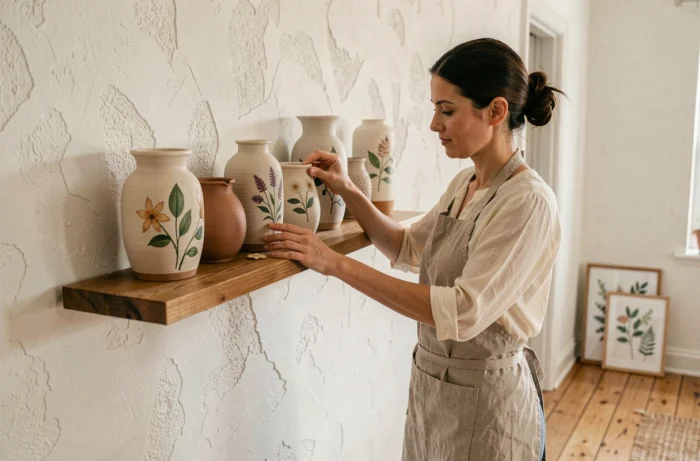
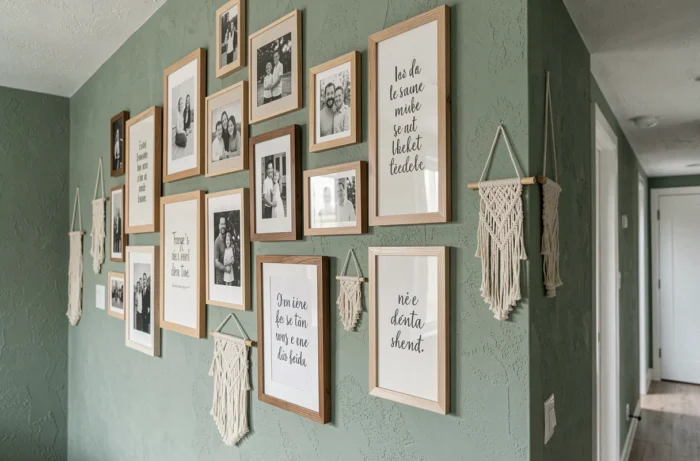
The gallery wall is no longer limited to framed photo prints. The current trend combines personal photographs, graphic prints, mirrors of various sizes, narrow wall shelves, and elements made of natural materials (driftwood, ceramics, stretched textiles).

Combining different textures creates depth and breaks the catalog effect. A raw wood frame next to a glass-covered print, itself next to a small brass mirror, produces a controlled contrast. The key lies in the common thread: a limited color palette or a shared theme.
Here are the elements to combine for a successful gallery wall:
- Photo prints in various formats (from small squares to large portraits) printed on matte or satin paper according to the desired ambiance
- One or two modestly sized mirrors that reflect light and visually enlarge the room
- A thin wall shelf holding small objects (plant, candle, ceramic) to add volume to the flat composition
- A textile or plant element (macramé, dried branch) that breaks the geometry of the frames
Lighting plays a often underestimated role. Positioning the composition facing a natural light source enhances the colors. Adjustable accent lighting (track lights or recessed spots) highlights the textures in the evening.
Personalized decoration without renovations: reversible solutions for renters
Personalizing a rental interior without altering the walls requires working with removable systems. Textured wall stickers now imitate wood, stone, or zellige with a realism that previous versions did not achieve. Their installation requires no tools, and their removal leaves no trace on well-maintained paint.
Self-adhesive decorative panels made of acoustic felt serve a dual purpose: dressing a wall and reducing sound reverberation. In a living room or office, the improvement in acoustic comfort is felt from the first listen.
String lights and suspended compositions
Micro-LED string lights on copper wire, stretched between two adhesive hooks, can structure an entire wall. You can attach polaroids, postcards, or business card-sized prints with simple wooden clips. This modular approach allows for refreshing the composition with the seasons without any heavy investment.
Suspended rods (wood or metal bars fixed with a cord) offer an alternative to traditional frames. A large-format print simply held by magnetic clips on a brass bar gives a contemporary look that is easy to change.
Wall decoration in the kitchen and bedroom: adapting the support to the room
The kitchen imposes specific constraints: humidity, grease splashes, temperature variations. Classic glass-covered photo prints get dirty quickly. We recommend prints on brushed aluminum or plexiglass, resistant to wet wiping and insensitive to steam.
In the bedroom, the trend is towards a personalized headboard. A panel made of spaced wooden slats, a large printed canvas, or an arrangement of frames creates a focal point without additional furniture. The decorative headboard replaces the classic painting and structures the sleeping area.
Personalized decoration gains coherence when it takes into account the function of each room, the nature of the walls, and the conditions of use. A well-decorated interior is not one that accumulates the most objects, but one where each element has been positioned, fixed, and illuminated according to thoughtful technical choices.