A homeowner receives their energy performance certificate (DPE) rated F, considers insulation and heating work, then discovers that the cost of estimates far exceeds their savings capacity. Energy renovation is not hindered by a lack of willingness, but by an immediate cash flow problem and a lack of clarity in the process. Reducing energy bills while acting for the planet requires solving this financial equation even before choosing an insulator or a heat pump.
Financing energy renovation without available cash flow
It is evident on the ground: many households abandon their project not because aids do not exist, but because they need to advance the amounts before being reimbursed. Public schemes like MaPrimeRénov’ or the eco-PTZ cover a significant part of the cost for low-income households, but the remaining costs and the cash advance remain the primary barrier.
The eco-PTZ, a zero-interest loan dedicated to renovation work, allows borrowing without interest to finance the balance. It can be combined with MaPrimeRénov’ to limit the initial effort. The average cost of work per housing unit has increased in recent years, making this financial arrangement even more strategic.
Specialized platforms like refair.fr connect housing diagnostics, certified craftsmen, and aid application processes, streamlining the chain between the signed estimate and the actual disbursement of subsidies.
Before starting a project, three points are checked: eligibility for Anah aids based on income, the possibility of taking out an eco-PTZ from their bank, and the ability of the RGE craftsman to produce a quote that meets the requirements of the application. Skipping one of these steps risks a subsidy refusal after the work is completed.
Order of renovation work: insulation, heating, ventilation
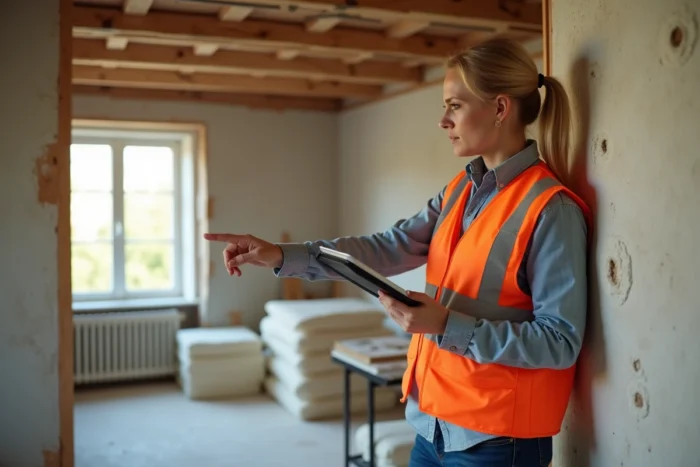
There is a strong temptation to replace the boiler first, as it is the equipment that is most visible on the heating bill. On the ground, this logic often leads to oversizing the new system. Insulating before changing the heating reduces the thermal demand of the housing and allows for the installation of smaller, cheaper, and more efficient equipment.
Insulation of attics and walls
Lost attics concentrate the most accessible thermal loss to address. The cost per square meter remains moderate, and the gain in heating consumption can be measured from the first winter. External wall insulation is significantly more expensive, but it eliminates thermal bridges that internal insulation does not address.
Replacement of the heating system
Once the envelope is treated, the heating system is sized according to the actual need. Air-water heat pump, pellet boiler, efficient log insert: the choice depends on the climate, surface area, and existing network. Feedback varies on this point, as actual performance depends as much on the quality of installation as on the equipment itself.
Controlled mechanical ventilation
A well-insulated home without appropriate ventilation accumulates humidity. Double-flow VMC recovers heat from outgoing air and further reduces heating consumption. It is often the forgotten link, even though it conditions both the comfort and durability of the insulation.
Real savings on bills: what renovation changes concretely
The national monitoring of the residential stock, led by the Ministry of Ecological Transition, now measures the average gains per housing unit after renovation. The focus has shifted from a logic of “number of processed files” to a results-driven approach, which encourages documenting the actual reduction in energy consumption rather than just theoretical estimates.
In practice, a comprehensive renovation (insulation, heating, ventilation) produces savings far superior to isolated actions. For example, changing windows alone improves acoustic comfort but does little to reduce the bill if the walls and attics remain leaky.
The areas where the reduction in consumption is most measurable include:
- Heating, which represents the majority of energy consumption in a home rated E, F, or G, with a gain proportional to the level of insulation achieved after work.
- Hot water production, often overlooked, which can be coupled with a thermodynamic water heater to halve the dedicated electricity consumption.
- Lighting and ventilation, whose relative share increases once heating is optimized, justifying a review of the entire electricity consumption of the home.
The DPE after work materializes this gain. Moving from class F to class C or D has a direct impact on the property’s real estate value, in addition to reducing the monthly bill.
Quality of execution: the risk that the announced performance may not be met
The recent debate in the sector focuses less on the principle of renovation than on the gap between announced savings and observed savings. Several factors explain these discrepancies.
The first is the installation. Poorly sealed insulation, a poorly adjusted VMC, or an undersized heat pump negate part of the theoretical gain. The RGE certification of the craftsman is a prerequisite for obtaining aids, but it does not alone guarantee the quality of execution.
The second factor concerns the habits of the occupants. A renovated home heated to a higher temperature than before the work consumes more than expected (this is the rebound effect). Adapting usage after renovation conditions actual savings.
To secure the result, one can require a compliance visit after the work and request a consumption follow-up for the first year. Some approved partners by Anah include this follow-up in their service.
Energy renovation remains the most direct lever to sustainably reduce energy bills and emissions related to housing. The financial arrangement, the order of work, and the quality control of execution form a triptych that must be addressed together. Neglecting one of the three compromises the results on the other two.