
When booking a TGV or Ouigo online, we often validate a bit too quickly, and the name displayed on the ticket does not match the actual traveler. Typo, forgotten maiden name, ticket purchased for someone else: this situation is common, and the SNCF’s response on this point remains more rigid than what is found in air travel.
SNCF Nominal Ticket: What the Rule Really Imposes
Since identity checks have been strengthened in French railways, the consistency between the name on the ticket and the traveler’s ID is no longer an administrative detail. It is a matter of legal traceability related to rail safety. A conductor can deny access to the train if the name does not match, especially on routes with mandatory reservations (TGV INOUI, Ouigo, long-distance Intercités).
On TER and some Intercités without reservations, the ticket is not always nominal. Therefore, the issue of changing the name only arises for transport titles where the identity is explicitly stated on the e-ticket or printed ticket.
When trying to change the name on an SNCF ticket, one quickly discovers that the company does not offer a dedicated function to correct or transfer a name. The procedure involves a workaround: cancel the existing ticket, then purchase a new one with the correct name.
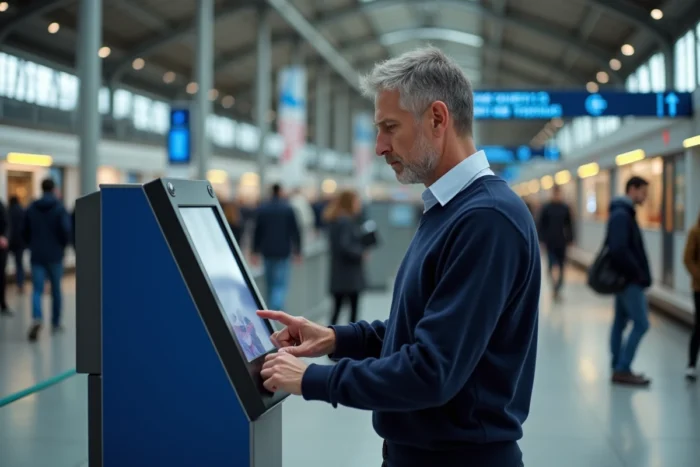
Changing the Traveler’s Name on SNCF Connect: The Concrete Steps
There is no “change name” button on SNCF Connect. The only official option is to exchange or cancel the ticket, then buy a new one. Here’s how to proceed based on the cases.
Exchangeable or Refundable Ticket
If the ticket was purchased with flexible conditions (exchangeable Second Leisure fare, for example), it can be canceled from the SNCF Connect personal space, the amount can be recovered in the form of a voucher or refund, and a new order can be placed in the correct name. The operation takes a few minutes.
Non-Exchangeable, Non-Refundable Ticket
This is the most frustrating case. For a Ouigo ticket or a locked Prem’s fare, no modification is possible. The ticket is lost if the name does not match the traveler. Responses vary on this point: some travelers report that conductors tolerate a simple typo (missing accent, shortened first name), but nothing guarantees this.
Purchase via a Third-Party Platform
For tickets purchased on Trainline or other resellers, the rule remains the same since the carrier is SNCF. The sales platform cannot change the name either. One must go through the customer service of the relevant platform to request an exchange or refund, depending on the fare conditions of the ticket.
Plane vs. Train: Why Name Correction is Free in Flight and Charged on Rail
The contrast deserves attention. In European air transport, a recent agreement regulates the free correction of minor name errors on airline tickets. A typo, a first name/last name inversion: the airline must correct it at no cost.
On the rail side, nothing comparable exists. SNCF does not distinguish between a typing error and a change of traveler. Both cases go through the same cancellation and repurchase procedure. Voices in the associative and media sectors point out that airline practices could serve as a reference to demand similar conditions in rail transport.
For the traveler, the direct financial consequence is significant: on a discounted train ticket, correcting a misspelled first name can cost the entire price of the ticket if it is neither exchangeable nor refundable.
Tips to Avoid Losing Your SNCF Ticket Due to a Wrong Name
Rather than trying to correct it afterward, a few reflexes can help avoid the problem.
- Check the name before validating payment: SNCF Connect displays a summary before purchase. Taking ten seconds to reread the full name, including any accents and hyphens, can prevent many complications.
- Use the exact name as it appears on the ID card or passport, not a nickname or commonly used first name. The conductor compares the ticket to the ID.
- Opt for an exchangeable fare when booking for someone else. The price difference with a non-modifiable ticket is justified if the traveler’s identity is not yet certain.
- On routes where the ticket is not nominal (some TER, regional buses), the issue does not arise. Checking the nominal nature of the title before purchase allows one to know if a name error will be problematic.

Special Case of Night Trains and Privatized Compartments
On night Intercités, it is possible to privatize a sleeper compartment. In this configuration, the rules regarding the traveler’s name may apply differently. The ticket is linked to the compartment reservation, and the sensitivity to the exact name is sometimes lower when the group occupies the entire reserved space.
This is not an official guarantee, but an observation: conductors on night trains mainly check the consistency between the number of travelers and the number of reserved berths. A small spelling error on a name is more easily overlooked in this context than on a TGV during peak times.
Buying a Ticket in the Correct Name Rather Than Trying to Modify
When an exchange or free refund is possible (occasional promotional operations, strikes, disruptions), buying a ticket in the correct name often costs less than attempting a transfer. SNCF sometimes offers periods where exchanges are temporarily free, and it is during these windows that one should act.
The procedure for changing a name on an SNCF ticket remains, therefore, an absence of procedure: one cancels and starts over. As long as French railways do not adopt a correction mechanism comparable to that of air transport, the best reflex remains vigilance at the time of booking.