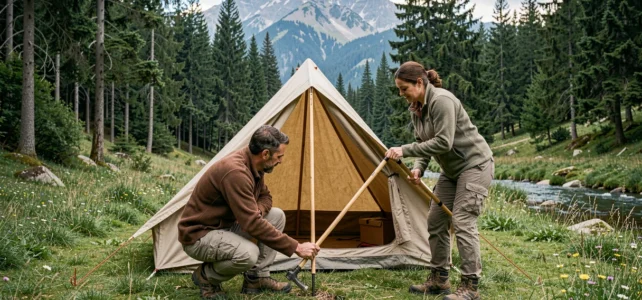
Finding a good spot to pitch your tent in the great outdoors is not just about spotting a pretty landscape on a map. The ground beneath your feet, local regulations, and even the direction of the wind in the morning can radically change the experience. Successfully camping with a tent site requires considering several concrete criteria, often overlooked in traditional guides.
Reading the ground before choosing your tent site
Have you ever been woken up by a puddle under your air mattress? The problem rarely comes from the tent. It comes from the ground.
A spot that seems perfect in the late afternoon can become a trap at night. Short, dense grass is the best indicator: it signals well-draining, compact soil that won’t hold water in case of a downpour. Conversely, tall, lush vegetation often betrays a wet area or an old water passage.
Always avoid depressions and the bottoms of slopes, even slight ones. Rainwater accumulates there within minutes during a nighttime storm. Opt for a very slightly raised or gently sloping surface, with the head oriented upwards.
The nature of the ground also matters for sleeping comfort. Sandy or grassy terrain cushions better than rocky or clayey soil. Before staking your tent, test the ground’s resistance: if the stake sinks effortlessly by hand, the ground is too loose to hold up in strong winds.
Campers looking for a camping site for tents in the wild benefit from spotting these ground details even before checking the site’s photos.
Camping regulations in France: what the ground doesn’t tell you
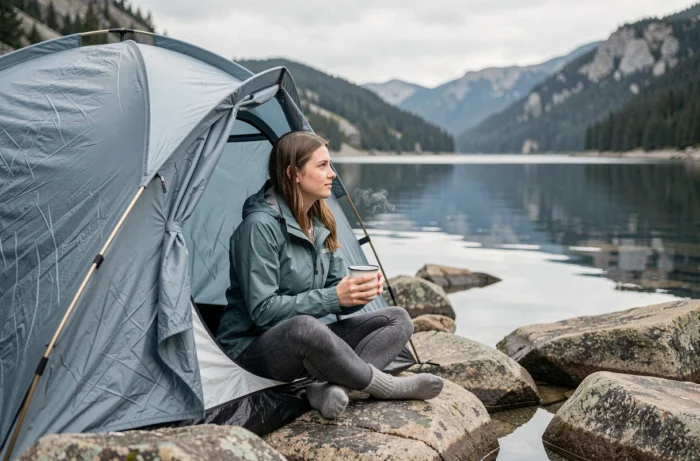
French law allows isolated camping by default, but this apparent freedom is riddled with local restrictions. Confusing bivouacking with wild camping can lead to fines or even eviction in the middle of the night.
Bivouacking and wild camping: two distinct practices
Bivouacking refers to a temporary setup, generally from sunset to sunrise, without any facilities. Wild camping involves a longer stay with deployed equipment. Most French national parks allow bivouacking but prohibit wild camping on their territory.
In regional parks, the rules vary from one park to another. Some tolerate bivouacking outside central areas, while others completely prohibit it during the summer months, particularly due to fire risks.
Common prohibition zones
- Coastal shores (littoral strip), where camping is prohibited regardless of the duration of the setup
- Classified sites and nature reserves, with specific prefectural orders for each area
- State forests subject to seasonal restrictions, especially in southern France between June and September
- The immediate vicinity of drinking water points and catchments, often marked on-site
Always check local regulations before you go, by consulting the relevant park’s website or contacting the town hall. Municipal orders can prohibit camping throughout the entire municipal territory, even outside protected areas.
Nature sites in certified camping: an underestimated alternative
In light of increasing bivouacking restrictions and the contraction of bare pitch offerings in campsites, finding a true tent site in the wild within a developed structure is becoming more difficult. Sector data for the period 2019-2024 shows a 13.2% decrease in bare pitches in France, while equipped pitches like mobile homes have increased by 17.3%.
This trend masks an opposite phenomenon: the demand for nature tent sites is on the rise. Several campsites are repositioning part of their offerings towards wooded plots, without concrete slabs or mandatory hookups, to cater to this clientele.
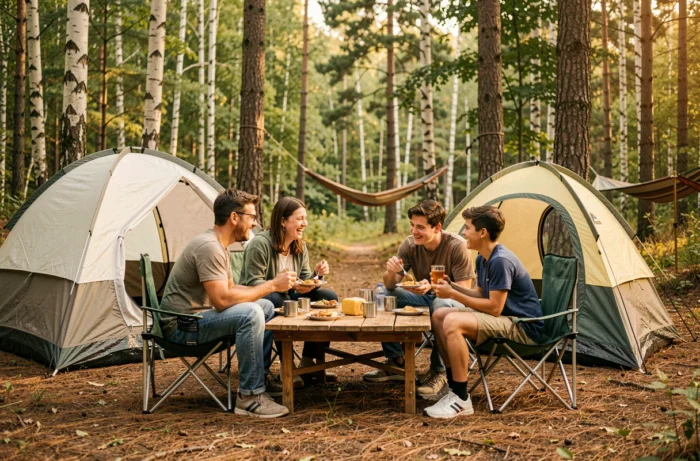
How to spot these sites? Look for campsites that explicitly mention “bare pitches” or “nature pitches” in their descriptions. Labels like Camping Qualité identify establishments that maintain this type of offering with a verified specification.
Concrete criteria to filter good sites
- Minimum plot size: a plot that is too small (less than about 80 m²) makes cohabitation with neighbors difficult, especially with an awning or cooking space
- Presence of natural shade: mature trees on the plot significantly improve comfort in summer, much more than a parasol or awning
- Distance to sanitary facilities: too close, noise and light can be bothersome at night; too far, the back-and-forth becomes burdensome with children
- Access to a water point on the plot or in the immediate vicinity, to avoid crossing the entire campsite with jerry cans
Orientation and exposure: the detail that changes the tent stay
An oriented site can turn your tent into an oven by 7 a.m. in summer. Prefer a west or northwest exposure for a gentle wake-up and a gradual rise in temperature.
The wind is another underestimated factor. Position the tent entrance away from the prevailing wind. In the mountains, breezes descend from the peaks at night (catabatic wind) and rise in the morning. By the sea, the land breeze blows at night and the sea breeze takes over during the day.
Natural shelter also plays a protective role. A hedge, a wall, or a forest edge reduces wind exposure without blocking ventilation. A sheltered site consumes less nervous energy: the fabric flaps less, sleep is better, and equipment lasts longer.
Ultimately, choosing the right spot for your tent in the great outdoors relies on a few simple reflexes: reading the ground, checking regulations, filtering campsite offerings based on concrete criteria, and considering orientation. These details separate a memorable stay from a night to forget.