
A dog limping after a bad landing at the park, a cat refusing to eat for two days: the first reaction is to rush to the veterinarian. The bill can then reach several hundred euros, and without pet health insurance, it remains entirely the owner’s responsibility.
In France, the coverage rate for dogs and cats remains very low compared to countries like Sweden or the United Kingdom. Understanding what the contracts actually cover, and especially what differentiates them, helps avoid paying for inadequate protection.
Increase in veterinary costs: a trend that changes the game for your budget
Veterinary care in France has been increasing by about 4 to 6% per year since 2020, according to the 2026 pet insurance price barometer published by Je-Simule. This rate exceeds general inflation. In practical terms, the same procedure (X-ray, dental scaling, blood test) costs significantly more each year.
This increase is explained by advances in medical imaging, specialized surgery, and the growing sophistication of care protocols. For an owner without insurance, each unexpected consultation weighs more heavily on the budget.
Have you compared the price of a cruciate ligament surgery five years ago to the one charged today? The difference illustrates this structural trend well. In light of this reality, a well-chosen insurance acts as a sustainable financial buffer, not just as a one-time discount.
Before signing a contract, it makes sense to compare pet insurances to identify the plan that truly absorbs this inflation in care, rather than relying on the first quote received.
Reimbursement ceiling, deductible, and waiting period: the three criteria that make the difference
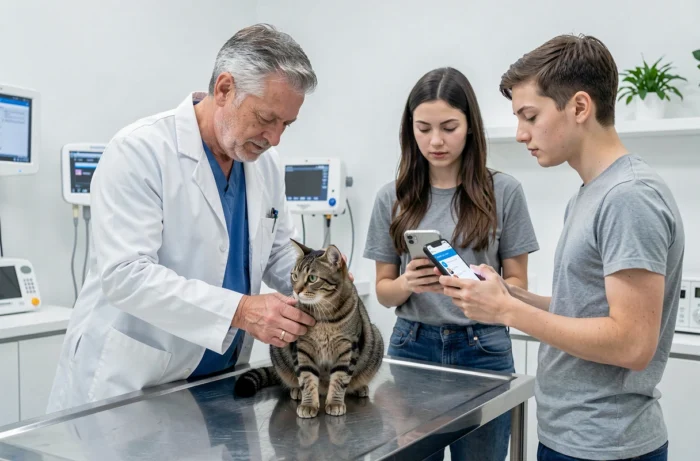
Two contracts showing the same monthly premium can offer radically different protections. Everything hinges on the technical details, and three parameters deserve special attention.
The annual reimbursement ceiling
This is the maximum amount that the insurer reimburses in a year. A low ceiling (a few hundred euros) is sufficient for routine care. However, in the case of hospitalization or major surgery, a ceiling that is too low leaves the owner to pay the majority of the bill.
The deductible per procedure or per year
The deductible is the amount that remains your responsibility before reimbursement starts. Some contracts apply a deductible per procedure (each visit), while others have an annual deductible (once a year). The cost difference over a year with multiple consultations can be significant.
The waiting period
After subscribing, there is a period during which care is not yet covered. This waiting period varies by insurer and by type of coverage (accident or illness). A short waiting period for accidents and a reasonable one for illnesses are indicators of contract quality.
Here are the points to check systematically before signing:
- The annual reimbursement ceiling and whether it covers major surgical procedures in addition to routine care
- The type of deductible (per procedure or annual) and its exact amount in euros
- The duration of the waiting period for accidents, illnesses, and possibly preventive care
- Breed or age exclusions that could render the contract inapplicable to your pet
Dog and cat insurance plans: what each level actually covers
Most insurers offer three levels of plans. Their names vary (basic, comfort, premium), but the logic remains the same. It is the coverage scope that changes, not just the price.
The basic plan covers only accidents: fractures, ingestion of a foreign body, bites. It does not cover illnesses, which significantly limits its usefulness for an aging pet or a breed predisposed to certain pathologies.
The intermediate plan adds illness coverage: infections, tumors, chronic digestive disorders. It is often the best compromise between premium and actual protection.
The high-level plan generally includes preventive care: vaccinations, deworming, dental scaling, sometimes sterilization. This level of coverage is especially justified for a puppy or kitten, whose first months involve a lot of preventive care.

The displayed reimbursement rate (60%, 80%, 100%) applies after deducting the deductible and within the limit of the ceiling. A contract that reimburses at 100% with a very low ceiling may ultimately cover less than a contract at 80% with a high ceiling.
Pet insurance in France: an underutilized market that is evolving quickly
About 800,000 pets were insured in France in 2023, while the country has 22.5 million dogs and cats. The penetration rate remains marginal compared to Sweden (about 80% of pets covered) or the United Kingdom (around 40%).
This gap means that the majority of French pet owners bear the full cost of veterinary expenses. When an accident occurs, the lack of coverage can lead to forgoing necessary care or going into debt to finance it.
The market is changing nonetheless. New players are entering, online comparison tools are developing, and plans are diversifying. This competition benefits owners, provided they take the time to analyze the offers rather than signing up for the first one they find.
- Established insurers offer comprehensive plans but often at higher prices, with a network of partner veterinarians
- Insurtechs focus on quick online subscriptions, reduced waiting periods, and simplified management interfaces
- Comparison tools allow users to compare ceilings, deductibles, and exclusions of several contracts in just a few minutes
Comparison does not guarantee finding the perfect contract. However, it does ensure avoiding unsuitable contracts, those whose ceiling does not cover a common surgery or whose exclusions render illness coverage theoretical.
Comparing three or four offers takes a quarter of an hour and is often enough to identify the contract that truly matches your dog or cat’s profile.