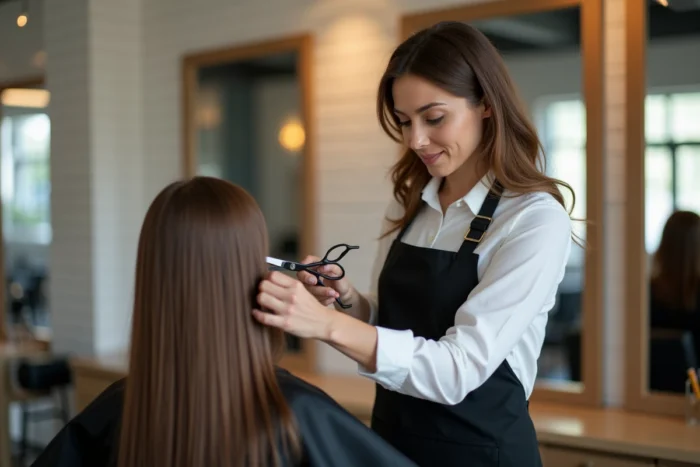
Thinning hair involves reducing the hair fiber in certain areas of the cut, mainly the tips and lengths, to decrease volume without shortening the hair. This cutting technique differs from layering, which alters the overall structure of the hairstyle by creating varying lengths. Thinning, on the other hand, works on the material: it lightens, refines, and adds movement to a hair mass that is too dense.
Thinning and layering: two technical gestures not to be confused
The confusion between thinning and layering often arises, even in salons. Layering creates an architecture in the cut by overlapping strands of varying lengths. It gives shape, fall, and silhouette. Thinning occurs after or during this structuring to lighten the mass without changing the line.
In practice, a hairstylist can combine both techniques on the same cut. A layered cut on thick hair without thinning produces a correct but heavy shape. Thinning then complements to soften the tips and fluidify the movement. Recent hair content presents thinning as a complementary technique to layering, with a clearer distinction between structure and lightening.
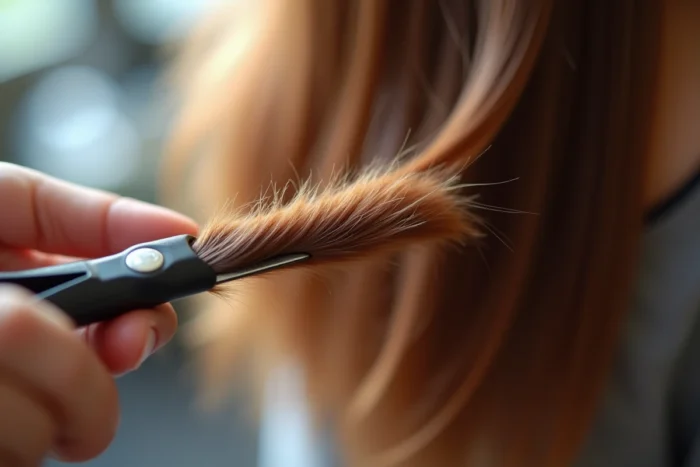
One can thin hair, as Zaturelle advises, using several tools for thinning: sculpting scissors (with teeth), a razor, or straight scissors in a point-cutting technique. Each tool produces a different result on the material.

Sculpting scissors, razor, point-cutting: which tool for which effect
The choice of tool determines the final result as much as the stylist’s gesture. Each instrument acts differently on the hair fiber.
- Sculpting scissors (thinning scissors) have a serrated blade that cuts part of the strands while leaving the other intact. They remove material evenly and progressively, which is suitable for thick or wavy hair that needs regular lightening.
- The razor slices the strand at an angle, creating very fine tips and a pronounced movement effect. The result is more textured, sometimes more deconstructed. On fine hair, the razor can weaken the fiber and cause split ends.
- Point-cutting with straight scissors involves cutting small sections of hair by poking into the strand with the tips of the scissors. This technique offers precise control and a natural finish on the cut edges (bangs, nape, face contours).
An experienced stylist often chooses to combine two of these techniques on the same cut. Sculpting scissors for the bulk of the work on lengths, point-cutting for the finishing touches around the face.
Thick, fine, or curly hair: thinning is not suitable for all types
Thinning works remarkably well on thick and heavy hair. Removing material from the lengths and tips restores flexibility, facilitates styling, and allows curls to form better. On thick hair, the effect is immediate: the cut appears lighter and the movement more fluid.
On fine hair, the situation changes. Excessive thinning on fine hair visually impoverishes the mass and gives the tips a sparse appearance. Recent professional content emphasizes this limitation. Thinning should be used sparingly on this type of hair, focusing on the edges and finishes rather than the structure of the cut.
Curly hair presents a particular case. Despite their apparent volume, their fiber is often fine and fragile. Thinning within the structure of a cut on curly hair risks creating areas of weakness, with breaks at mid-length. Light point-cutting on the contours remains the safest approach.
The trap of systematic thinning in salons
Some salons use thinning as a default technique on all cuts, regardless of hair type. This standardized approach does not take into account the nature of the fiber. Thinning already fine hair essentially means undoing, strand by strand, a material that already lacks density.
Before requesting thinning, it is better to identify whether the volume comes from the hair’s diameter or the number of hairs. A large number of fine hairs creates volume without thinning being the right answer. A well-placed layering often suffices to structure the mass without thinning the fiber.
Maintenance after thinning: a cut that requires regular follow-up
Thinning produces an appealing result when leaving the salon, but this cut evolves quickly. The thinned tips grow back unevenly. Within a few weeks, the hair can lose its shape and appear messy rather than textured.
Regular touch-ups in the salon are necessary to maintain a harmonious result. This maintenance requirement is rarely mentioned, but it impacts the budget and organization. Textured short cuts (pixie, bixie, micro-bob) that incorporate thinning require a salon visit every four to six weeks to maintain their structure.
Daily styling also matters. On damp hair, applying a texturizing product before drying helps redefine the movement created by thinning. Drying the head upside down with a diffuser amplifies curls and waves without weighing down the tips.
- Space out shampoos to avoid puffing up the roots while keeping the tips fine
- Use a leave-in treatment on the lengths to smooth the scales opened by the cut
- Avoid flat irons on very thinned tips, which do not handle concentrated heat well on a thin material
Current cuts that benefit from thinning
Thinning finds its best expression in cuts that play on texture and volume contrast. The Spanish layering, very present in recent trends, combines structured lengths with generous thinning on the tips for a natural movement effect around the face.
The textured micro-bob uses thinning to break the straight line of the classic bob. The lightened tips move more and give a less rigid appearance. On wavy hair, this type of cut highlights curls without weighing them down.
Thinning serves movement, not structure. A well-layered cut does not always need thinning. But when the material remains too dense after layering, a few cuts with sculpting scissors on the lengths can transform the result. The key remains the dialogue with the stylist before the cut, specifying the desired texture rather than simply asking to “thin out.”