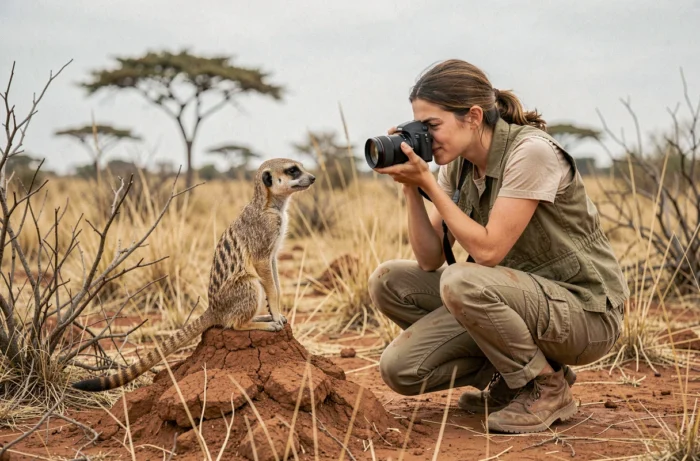
Animal behavior is not limited to documentaries about large predators. Each species, from mosquitoes to woodpeckers, develops strategies that directly modify its ecosystem, sometimes measurable only through recent technologies. The world of animals is better understood when we go beyond surface curiosities to examine what contemporary research reveals.
Environmental DNA and camera traps: making animal behaviors visible
Direct observation has long been the only tool for studying wildlife. It remains useful, but its limitations are documented: a human observer, even an experienced one, misses a portion of the interactions between species.
The USGS published research results on September 9, 2026, showing that camera traps and environmental DNA detect visitors invisible to direct observation. Around cavities excavated by woodpeckers, these tools identified additional birds, mammals, and invertebrates that had not been previously spotted.
This type of discovery changes the understanding of an species’ ecological role. A woodpecker does not just search for insects in the wood: it creates a micro-habitat that other animals depend on. Without technological monitoring, this chain of interactions remains invisible, and the resulting conservation decisions lack data. To delve deeper into such topics, articles on Animal Time regularly cover the behaviors of lesser-known species and their ecological interactions.
Mosquito behavior and public health: when wildlife alters health strategies
The link between animal behavior and human health goes beyond mere bites. Some mosquito populations have altered their habits in ways that make traditional prevention tools less effective.
Mosquitoes now bite more often outdoors or earlier in the day, reducing the effectiveness of treated mosquito nets. This behavioral change, documented by recent research, necessitates a rethink of strategies to combat vector-borne diseases.
This is not a trivial detail. In regions where malaria remains endemic, the treated mosquito net is the first line of defense. If the animal alters its biting behavior, the tool loses some of its relevance. Entomologists must then cross-reference behavioral data with epidemiological data to adapt health recommendations.
What this behavioral shift implies for research
Studying wildlife from a health perspective requires combining several disciplines. Ethology (the study of animal behavior in natural conditions) provides observations. Epidemiology quantifies the impact on human populations. Genetics identifies whether these changes are hereditary or plastic.
This convergence illustrates a point often overlooked: the behavioral curiosities of animals are not merely entertainment. They have direct and measurable consequences on human life.
Protected areas and species conservation: documented limitations
Creating a national park or reserve does not automatically guarantee the recovery of a species. A study published in the Journal of Applied Ecology in 2026, summarized by the University of Cambridge on September 15, 2026, provides a nuance rarely articulated so clearly.
Most species already under care are in protected areas, but many require complementary measures. The study highlights a lack of evidence regarding the effectiveness of legal instruments and public policies concerning biodiversity.
Specifically, protecting a territory is not enough if the migratory behaviors of the species lead it outside the area. An animal that moves over long distances needs ecological corridors, not just a fenced perimeter.
What complementary measures for biodiversity
- Ecological corridors connect protected areas and allow species to maintain sufficient genetic mixing for their long-term survival.
- Behavioral monitoring through telemetry or environmental DNA identifies the actual areas of territory use, often more extensive than the administrative boundaries of the reserve.
- The adaptation of wildlife law is progressing in Europe: the European Parliament recently voted on the first EU rules regarding the welfare of dogs and cats, signaling an expansion of the legal framework applicable to animals.
Animal law in Europe: a changing legal framework
Animal law is evolving faster than biology textbooks suggest. In Europe, the agriculture committee of the European Parliament has voted on the first community rules governing the welfare of dogs and cats.
This vote marks a paradigm shift. Until now, European regulation focused on farm animals and threatened wild species. The extension of the legal framework to companion animals creates a precedent that could influence national legislation in each member state.
For naturalists and ethologists, this evolution has a practical consequence: behavioral study protocols will need to integrate new regulatory constraints. Observing a domestic animal in a scientific setting could, in the long run, be subject to stricter permissions.
Animal behavior and nature: why legal science gets involved
The gradual recognition of animal sentience in law is based on ethological data. Studies documenting pain, stress, or complex social behaviors in animals directly feed legislative debates. The link between behavioral research and the evolution of law is not abstract: each scientific publication on animal cognition can become an argument in a legislative text.
The animal world is not just a collection of astonishing facts. The behaviors of species, whether it’s a mosquito changing its biting hours or a woodpecker excavating a habitat for other animals, generate chain consequences on public health, conservation, and law. The next significant ethological discovery may not make the headlines, but it could change a health protocol or a piece of legislation.